



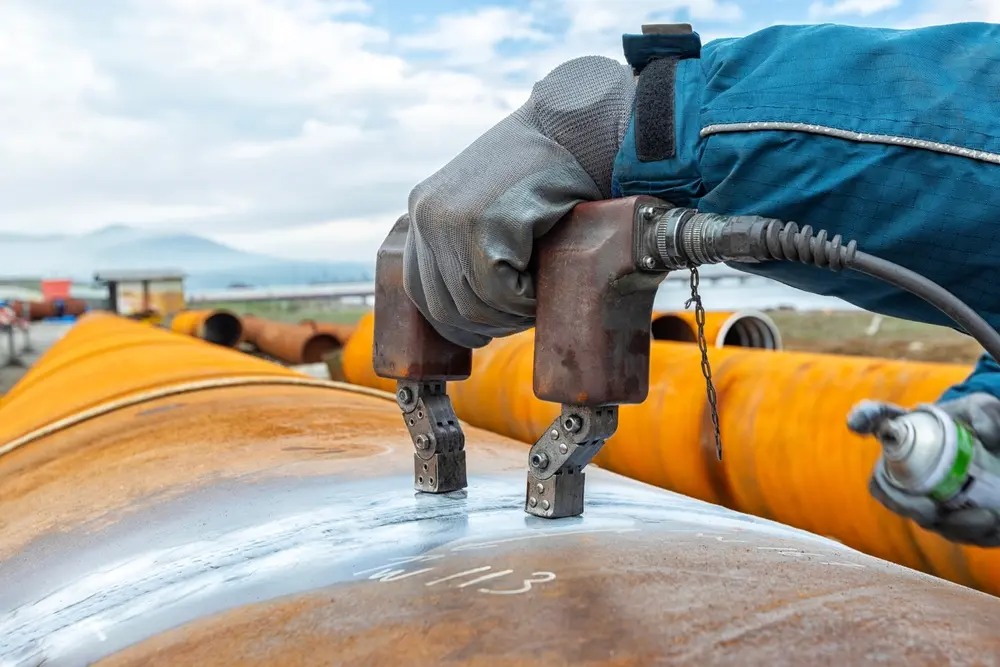
What is magnetic flux leakage? Magnetic flux leakage (MFL) is a nondestructive testing method used to identify corrosion, pitting and other areas of metal loss in ferromagnetic materials such as steel pipelines. MFL inspection gives operators valuable information about asset condition, helping them prioritize maintenance, verification and repair decisions before damage threatens reliability.
How Does Magnetic Flux Leakage Work?
In simple terms, magnetic flux is the invisible magnetic field that travels through a magnetic material. During an MFL pipeline inspection, an intelligent inspection tool, often called a smart pig, moves through the pipeline. Permanent magnet assemblies, which may incorporate rare-earth magnets, magnetize the steel pipe wall and create a magnetic circuit.
In an intact section of pipe, most of the magnetic flux remains within the steel. Corrosion or another area of missing metal reduces the space available for that magnetic field. Some flux is forced outside the pipe wall, creating magnetic flux leakage. Sensors positioned close to the wall detect these changes and record their location as the tool travels through the pipeline.
MFL sensors commonly include Hall-effect probes or coil-based sensors. Giant magnetoresistive sensors may provide greater sensitivity in specialized systems. Analysis software evaluates the amplitude and shape of the signals to characterize potential anomalies. High-resolution sensor arrays collect closely spaced readings, while machine-learning models can support signal classification and defect quantification when paired with proper calibration and validation.
Defect shape and orientation, magnetization strength, inspection speed and lift-off distance between the sensor and pipe wall can all affect signal quality. Learn more about this process in SMARTCORR®'s guide to magnetic flux leakage pigging.
What Pipeline Defects Can MFL Inspection Detect?
Magnetic flux leakage testing is especially effective for detecting internal and external corrosion, pitting and general wall loss in steel pipelines. Depending on the tool configuration and inspection conditions, it may also identify indications associated with gouges, grooves, scratches, weld anomalies and other changes in the pipe wall. High-resolution tools can detect small, localized anomalies, but minimum detectable size depends on the equipment, defect geometry and operating conditions.
MFL also has applications beyond pipelines. Specialized scanners can map thinning steel in storage tank floors, identify surface and internal defects in railroad tracks and detect broken wires or structural degradation in wire ropes. These systems use the same underlying principle but require equipment configured for the material and asset being inspected.
MFL does not provide the same level of sensitivity for every defect type. Narrow cracks or defects that do not cause meaningful metal loss may require another inspection technology. An integrity team should select its inspection method based on the material, geometry, operating conditions and primary integrity threats.
What Are the Benefits and Limitations of MFL Inspection?
MFL technology can rapidly screen long pipeline sections and collect detailed information without excavating the entire line. MFL tools can operate in gas and liquid pipelines, and inspections can often take place while the pipeline remains in service. The resulting data helps operators assess corrosion severity, prioritize further investigation and support pipeline integrity management.
Regular MFL assessments can also support compliance with applicable oil and gas pipeline safety regulations. Inspection frequency should be based on governing requirements, pipeline risk, operating conditions and inspection history rather than a single schedule for every asset.
MFL also has important limitations. It requires ferromagnetic material and infers metal loss from magnetic signals. It does not directly measure remaining wall thickness. Ultrasonic testing can provide direct thickness measurements and may be used to verify selected MFL indications. Combining complementary methods can provide a more complete understanding of pipeline condition.
SMARTCORR® Magnetic Flux Leakage Inspection Services
SMARTCORR® provides high-precision MFL in-line inspection tools for gas and liquid pipelines ranging from 6 to 56 inches in diameter. Its tools combine high-resolution detection with advanced software and AI-supported data analysis to help distinguish internal and external anomalies. SMARTCORR® can configure inspection technology for different pipeline diameters, wall thicknesses and operating conditions.
With more than 20 years of experience and more than 5,000 kilometers of pipeline inspected, SMARTCORR® provides the equipment and technical expertise needed to turn inspection data into practical asset integrity decisions. Explore SMARTCORR®'s MFL in-line inspection capabilities and request a quote to discuss the appropriate solution for your pipeline.